
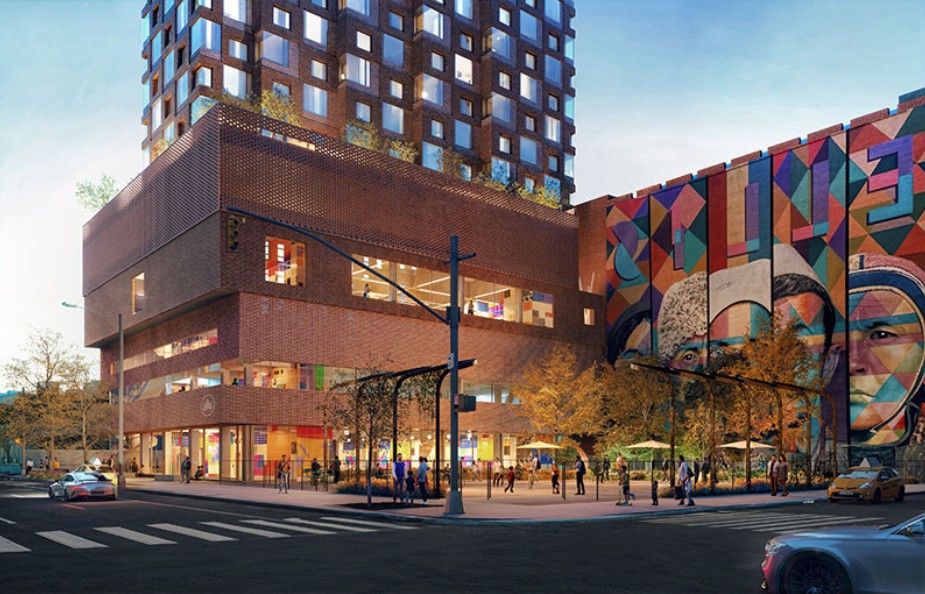
A 31-story tower proposed for 388 Hudson St. in Greenwich Village is drawing sharp opposition from neighborhood groups who say the developer behind it is among the city’s worst landlords and that promises of permanent affordability aren’t worth the paper they’re not written on.
The city picked Camber Property Group, alongside Services for the UnderServed and Essence Development, to develop the Hudson Mosaic project on city-owned land last December, in the final weeks of the Adams administration. Officials called it a first-of-its-kind development: roughly 280 homes paired with a publicly accessible recreation center. At approximately 400 feet, it would be the tallest building in Greenwich Village. Every unit is supposed to be permanently affordable, with rents ranging from 40 to 100 percent of Area Median Income.
Community groups aren’t convinced any of that holds.
Public Advocate Jumaane Williams ranked Camber’s founding principal, Rick Gropper, 17th on the city’s worst-landlord list. The New York City Department of Housing Preservation and Development data underpinning that ranking shows more than 1,000 open HPD violations tied to Camber-managed properties, along with 28 evictions. That record has become the central exhibit for residents who don’t trust the selection.
Andrew Berman, executive director of Village Preservation, a nonprofit that advocates for architectural and neighborhood preservation across Greenwich Village, NoHo, and the East Village, called the city’s developer choice a “questionable choice at best.” He’s not just talking about code violations.
Berman told the Evening Mail that the project’s physical design is itself a tell. The building’s height, the emphasis on river views for every apartment — it’s the profile of a luxury tower wearing affordable housing paperwork.
“They’re designing it to be as tall as possible. They talked about ensuring that every apartment had river views. It almost sounds as though it’s being designed to eventually become market rate,” Berman said.
That’s not a small concern for a neighborhood that’s watched affordable buildings get flipped or hollowed out through legal maneuvers over decades. Village Preservation wants binding contractual language that would make it legally impossible to convert units to market rate, not a verbal assurance offered at a community board meeting.
The city did mention a “regulatory agreement” with Camber at a recent Manhattan Community Board 2 meeting — something the city said would lock in affordability permanently. But Camber and city officials haven’t put the actual terms in writing for public review. Village Preservation wasn’t reassured.
“This is little changed from past statements from the City that claimed to offer guarantees without backing them up,” the group said.
Local resident and community activist Sommer Omar pressed city representatives at that same CB2 meeting, asking repeatedly which specific legal mechanism would actually enforce the affordability commitment. She didn’t get a straight answer. That kind of non-response lands differently when the developer has 1,000 open violations at its other properties.
AMNY’s coverage of the dispute captures how layered the neighborhood’s skepticism has become. It’s not simply opposition to new housing. It’s a specific distrust of the process, the developer, and a city that has, in the view of residents, handed them assurances before and then watched the buildings go luxury.
There’s also the sheer scale of what’s being proposed. At 400 feet, Hudson Mosaic wouldn’t just be the tallest building in Greenwich Village — it would change the neighborhood’s skyline in a way that can’t be undone. Berman and Village Preservation haven’t opposed affordable housing development in principle, but they’ve been consistent about wanting the density to match the neighborhood and the commitments to carry legal weight.
Plans call for 280 homes at full affordability. That’s a real number. The question is whether it stays that way in ten years, twenty years, or after the regulatory agreement — whatever it actually says — expires or gets renegotiated. With 28 evictions on Camber’s record and more than 1,000 open violations still unresolved, residents say the city didn’t pick a developer who earns the benefit of the doubt.
The city hasn’t released the text of any agreement with Camber. Village Preservation says it won’t stop pushing until it does.