
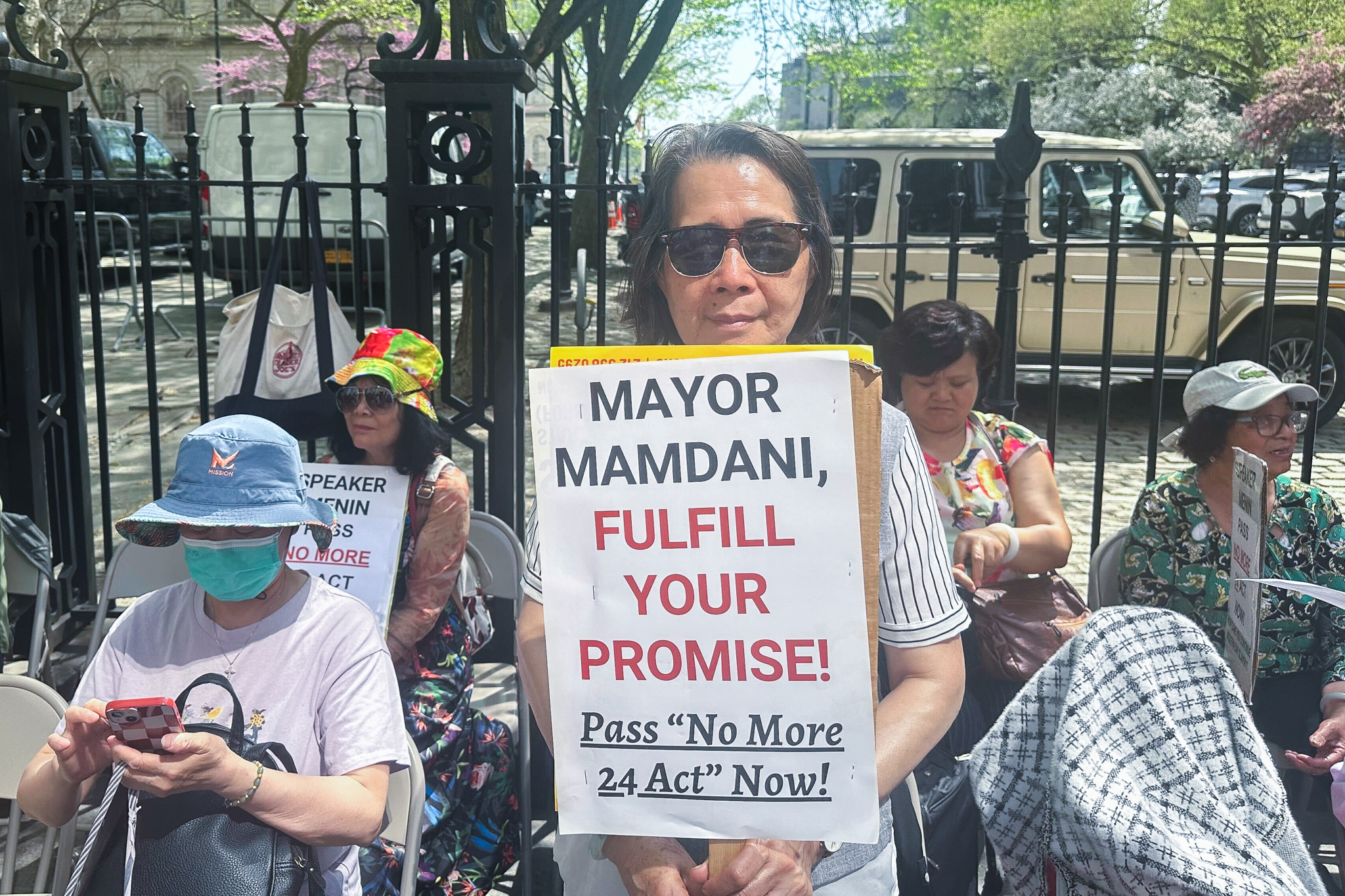
Fifteen home health aides began an indefinite hunger strike outside City Hall Thursday after the City Council let another session pass without a vote on banning 24-hour shifts in the home care industry.
The strikers sat in folding chairs in 85-degree heat beside the City Hall gates, joined by about 40 supporters waving signs that read “Stop the 24 Hr Work Day.” They started at 1:00 p.m. It wasn’t their first shot at this. Workers have been camped at the same spot for nearly a month.
Yunfang Zhang, 70, a home health aide who spoke through an interpreter, said she joined the strike because “home care workers cannot wait any longer, and our health has been destroyed.” She didn’t stop there. “We cannot allow this to continue to the next generation,” Zhang said.
The workers are almost all immigrant women. They’ve been pushing for more than a decade to end a state rule that lets employers pay live-in home care workers for only 13 hours of a 24-hour shift, provided the worker gets three hours for meals and at least five hours of uninterrupted sleep. In practice, workers say, they can’t sleep when a client needs them. Many describe going up to 96 consecutive hours inside the same home, getting paid for a fraction of that time. That’s the deal the Fair Labor Standards Act and its state counterpart have left largely intact for this workforce.
The legislation at the center of the fight was written by Councilmember Christopher Marte, who represents Chinatown. His bill would replace 24-hour shifts with 12-hour shifts covered by two separate workers. It’s not a complicated idea, but it’s broken up what should be a natural coalition. Workers’ rights groups back it. Many disability advocates don’t, at least not in its current form, because home care is so heavily funded by state Medicaid dollars that the city can’t simply redirect. Some worker allies, including a city agency that’s supposed to protect workers, say the bill can’t work without additional state funding. They’re worried it could leave patients without care and workers without income.
That funding fight has reportedly driven a wedge between Gov. Kathy Hochul and Council Speaker Julie Menin, with both ends of the state capital and City Hall pulling in different directions.
Mayor Zohran Mamdani said on the campaign trail he supported ending 24-hour shifts. His administration’s position since taking office has been more cautious. When The City asked him about the bill, Mamdani said he’s “long been supportive of any effort to recognize the immense labor of home care workers” and indicated he’d let the legislative process run. The women outside in the heat weren’t buying it.
Marte has said he’s optimistic a deal between himself, Menin, and Hochul is possible. Optimism doesn’t pay anyone’s rent. There’s been no Council vote.
This isn’t the first time these workers have gone without food to make the point. In 2026, they’re back at it. A similar hunger strike by roughly 24 home care workers in 2024 lasted six days before ending without a legislative win. Workers say they don’t see another move available to them.
New York’s home care workforce is concentrated heavily in Brooklyn and Queens, and the city’s aging population means demand for that labor isn’t shrinking. The workers doing it are mostly women of color, many of them immigrants, covered imperfectly at best by labor law. They can’t strike in the traditional sense without risking patient safety. They can’t easily take second jobs while working 96-hour stretches. So they sit outside City Hall in August heat, and they stop eating, because that’s what’s left.
Marte’s bill still needs a hearing before it can move to a floor vote. No date has been set.