
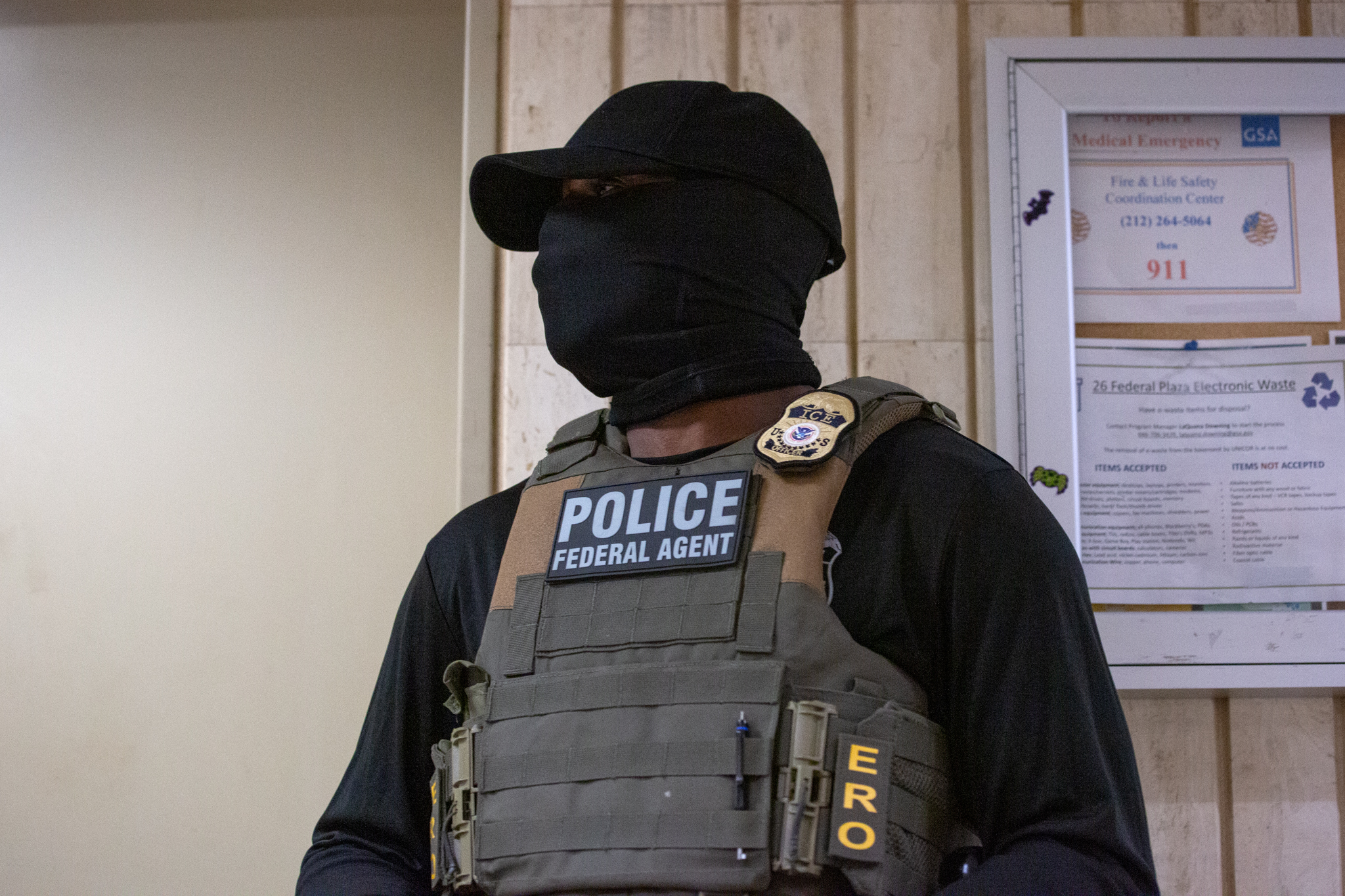
Nassau County police handed a Hicksville man to federal immigration agents following a late-night traffic stop in January 2026, the clearest local example yet of a coordination pattern that reaches well past New York City’s sanctuary protections.
The stop happened around 11 p.m. Officers pulled over the man and his girlfriend for a suspended registration. Both spent the night at the precinct. The next morning, officers released the woman with a desk appearance ticket. She watched her boyfriend leave in shackles, escorted by someone who identified himself as an FBI agent. He called her later that day from immigration detention, according to a habeas corpus petition filed in the Eastern District of New York.
That case isn’t isolated. THE CITY reviewed habeas petitions filed across New York and New Jersey courts between October 2025 and March 2026 and identified roughly three dozen arrests where local police departments allegedly coordinated with U.S. Immigration and Customs Enforcement. In each case, the immigrants involved had no advance warning.
Most of the cases came out of Nassau County, where sheriff and police department agreements with ICE are expansive. Those agreements fall under the federal 287(g) program, which effectively deputizes local officers to carry out immigration enforcement. But Nassau wasn’t alone. THE CITY also found cases in Port Chester, Mount Vernon, and Monticello. None of those municipalities hold formal agreements with the Department of Homeland Security. Local police and probation officers there allegedly tipped ICE to undocumented immigrants they’d encountered, rather than making the arrests themselves.
No sanctuary law. No 287(g) contract. Just a call.
Every case THE CITY identified occurred outside New York City’s sanctuary framework, meaning local agencies there aren’t legally prohibited from sharing information with federal immigration authorities or joining ICE operations. People inside the five boroughs have carried those protections for years. Someone 20 miles east in Hicksville, or north in Mount Vernon, doesn’t get that coverage.
That’s the gap the New York for All Act is designed to close. Sponsored by State Senator Andrew Gounardes of Brooklyn and Assemblymember Karines Reyes of the Bronx, the bill would restrict local law enforcement cooperation with federal immigration authorities except in narrow circumstances. It has dozens of co-sponsors and the backing of several immigrant rights organizations and the NYCLU. Deliberations in the state legislature are continuing.
Gov. Kathy Hochul’s position on the legislation has moved under competing pressure. She initially floated a narrower proposal, one that would end local jail contracts with ICE and terminate existing 287(g) agreements, but stop short of a statewide sanctuary mandate. Advocates pushing for the broader bill said that approach wouldn’t reach the informal coordination they’re seeing in places like Port Chester and Monticello, where there’s no formal agreement to terminate in the first place.
Eleven communities across New York state currently operate under 287(g) agreements, according to data from the Department of Homeland Security. Nassau County accounts for the largest share of the cases identified in THE CITY’s review.
“This is not done,” Hochul said, signaling she hadn’t closed the door on stronger action, though her office hasn’t committed to the full New York for All Act.
The 287(g) program, created under federal immigration law, allows the Department of Homeland Security to enter into agreements with state and local law enforcement agencies, training local officers to perform immigration enforcement functions that would otherwise be reserved for federal agents. Critics argue the program erodes community trust and exposes local governments to civil liability. Supporters say it lets local agencies flag serious public safety risks to federal authorities without waiting on an often-slow federal response.
The habeas petitions reviewed by THE CITY were filed in the Eastern District of New York as well as federal courts in New Jersey, with cases recorded from October 2025 through March 2026. In most instances, families said they had no idea local police were working alongside ICE until the moment of arrest.
The legislature’s deadline for the current session is approaching. Whether Hochul moves toward the broader bill or holds to a limited version will determine how many of the state’s 04 million-plus immigrants outside New York City have any statutory protection at all.