
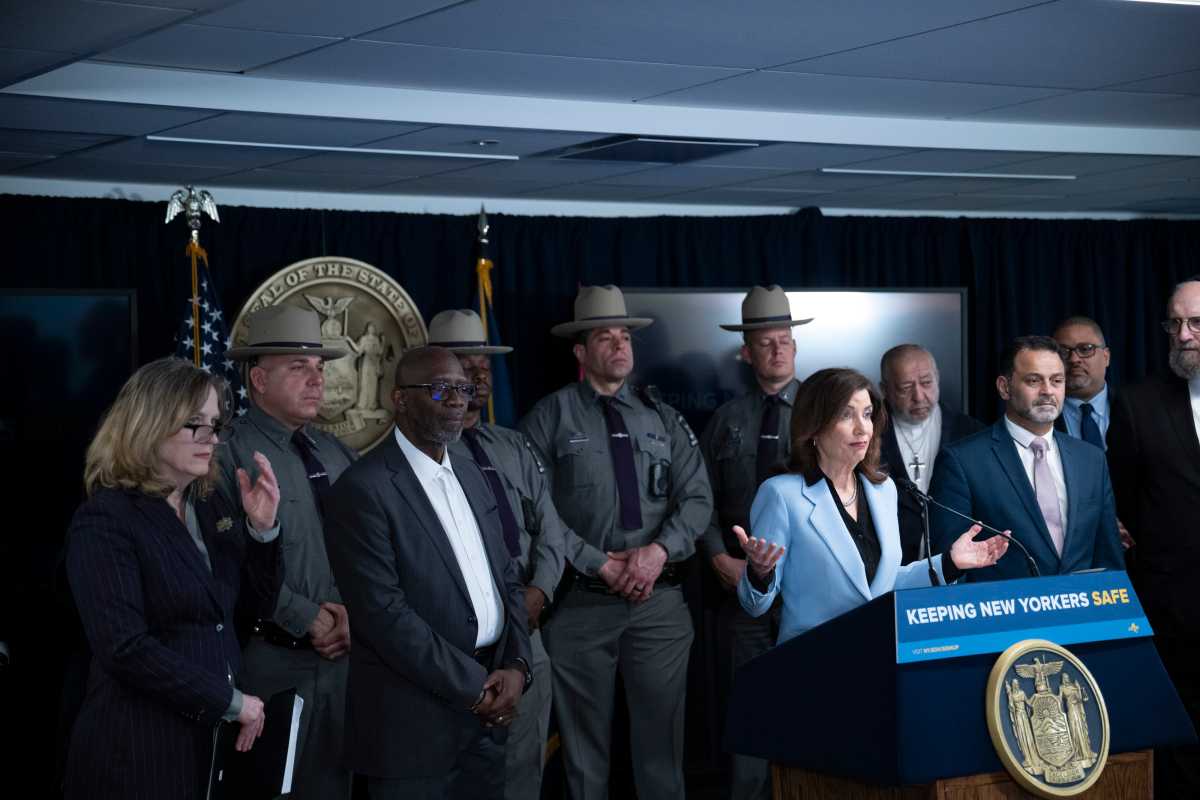
Gov. Kathy Hochul went back on offense Wednesday, pushing a 25-foot buffer proposal around houses of worship statewide and pairing it with $35 million in hate-crime security grants for vulnerable nonprofits.
It’s a fight she first picked in January during her fifth State of the State address. Now she’s picking it again, and this time she’s doing it with faith leaders at her side and a pointed message for anyone who wants to challenge her in court.
“Bring it on,” she said.
The proposal puts Hochul well to the right of where New York City lawmakers landed. The City Council passed something considerably narrower: a requirement that the NYPD publish its plans for managing protests near houses of worship, not an outright prohibition on where demonstrators can stand. Mayor Zohran Mamdani hasn’t signed it. Last month he told reporters the bills raised “serious” constitutional concerns, saying he was working to protect both “the right to prayer and the right to protest.”
Hochul didn’t back down Wednesday when reporters pressed her on whether a statewide buffer could survive court challenge. She argued 35 feet, then caught herself at 25, is a reasonable distance from a building’s entrance. The state, she said, has an obligation to protect the right to worship.
She also tried to draw sharp lines around how enforcement would actually work. Police wouldn’t be posted outside every church, mosque, and synagogue in New York. Enforcement would focus on locations where protests are already underway or expected, with the specific aim of letting worshipers reach a building’s entrance without running a gauntlet of demonstrators on the sidewalk.
The proposal’s origins trace to protests outside synagogues in Manhattan and Queens, including Park East Synagogue and a synagogue in Kew Gardens Hills. Those demonstrations put the issue in front of legislators in 2014, touched off a fight that outlasted one mayoral administration, and is now testing another. The politics don’t simplify the constitutional picture.
Brooklyn Council Member Shahana Hanif voted against the council bill. She said the legislation conflicted with the city’s existing protest settlement framework, gave police too much authority, and threatened protected speech by letting officers decide “when and where people can speak and organize.” That tension with Hochul’s position isn’t going anywhere.
The First Amendment question is real and it’s not going to dissolve because Hochul sounds confident. Buffer zone laws have a complicated track record in federal court. The Supreme Court struck down a 35-foot clinic buffer in McCullen v. Coakley, ruling it burdened more speech than necessary. A house of worship isn’t an abortion clinic, and Hochul’s team will argue the context is different. Courts may or may not agree.
Hochul brought a multi-faith coalition to the microphone Wednesday, and it wasn’t for show. Rabbi Yeruchim Silber of Agudath Israel said it’s critical that people of every faith be able to worship without fear. Mohammad Razvi of the Council of Peoples Organization described a surge in anti-Muslim hate and said congregations need resources to protect themselves. Rev. Robert Waterman of Antioch Baptist Church told the room about an intruder who walked into his church during a Dr. Martin Luther King Jr. Day service, made it all the way to the pulpit, and left his parishioners shaken.
That’s not a hypothetical. It happened.
The coalition gives Hochul political cover across denomination lines, which matters in a state as religiously diverse as New York. It doesn’t settle the legal argument, though. What a buffer zone does, constitutionally, is restrict expressive activity in a public space. Courts look hard at whether the government’s interest is significant, whether the restriction is narrowly drawn, and whether protesters still have other avenues to communicate. Hochul’s team will have to answer all three.
Mamdani hasn’t committed to signing the council bill sitting on his desk. Hochul’s statewide push now creates pressure from above. Whether Albany can pass something the courts won’t immediately gut is the question nobody’s fully answered yet.