
Mayor Zohran Mamdani has until April 25 to veto a City Council bill creating protest buffer zones around schools. His allies don’t want him to wait.
Nearly a dozen organizations delivered a letter to Mamdani on Friday demanding he reject the measure. The bill, passed by the Council on March 26, targets “educational facilities” — but critics say the definition is so loose it could rope in nearly every building in the five boroughs. The pressure lands at a moment when Mamdani hasn’t committed to a direction publicly, and the clock’s running out.
The Council passed two buffer zone bills that day. They’re not the same fight.
The religious sites measure cleared 44 to 5. That’s a veto-proof margin, and everyone knows it. Mamdani can’t touch it. The educational facilities bill is different: it scraped through 30 to 19, a margin thin enough that a mayoral veto would hold. That’s the one the letter targets, and that’s the one generating serious heat at City Hall.
The letter’s signatories include the steering committee of the People’s Majority, United Auto Workers Region 9A, the union representing CUNY professors, and Desis Rising Up and Moving, along with several other groups. Their objection isn’t to buffer zones in principle. It’s to what counts as a covered facility.
The bill doesn’t just cover traditional schools. It applies wherever “educational programming takes place,” language the groups say is expansive enough to swallow more than 200 public libraries and countless other locations across the city.
“By defining ‘educational facility’ as any place where ‘educational programming takes place’ and not solely traditional educational institutions, 175-B functionally subjects any building in this city to the proposed law, including the more than 200 public libraries,” the letter said.
That’s not a hypothetical worry. It’s a logistical one.
“The broad reach of the legislation again means that the NYPD must create a plan for just about every building in this city,” the letter said.
The groups called the bill a radical overreach that restricts free speech and puts New Yorkers at legal risk for demonstrating in places that have never been understood as schools.
Council Speaker Julie Menin isn’t backing down. She pushed both bills through and defended them as a direct response to a documented surge in hostility on New York streets. “The increase in hateful acts across the city is absolutely abhorrent, and we have to do something about it,” she said last month.
The bills didn’t come from nowhere. Both grew out of protests outside Manhattan and Queens synagogues where some demonstrators chanted support for Hamas. Those synagogues were hosting an organization that helps American Jews emigrate to Israel and the Israel-occupied West Bank. Mamdani drew criticism at the time, with some saying his initial comments didn’t condemn the pro-Hamas chants clearly enough.
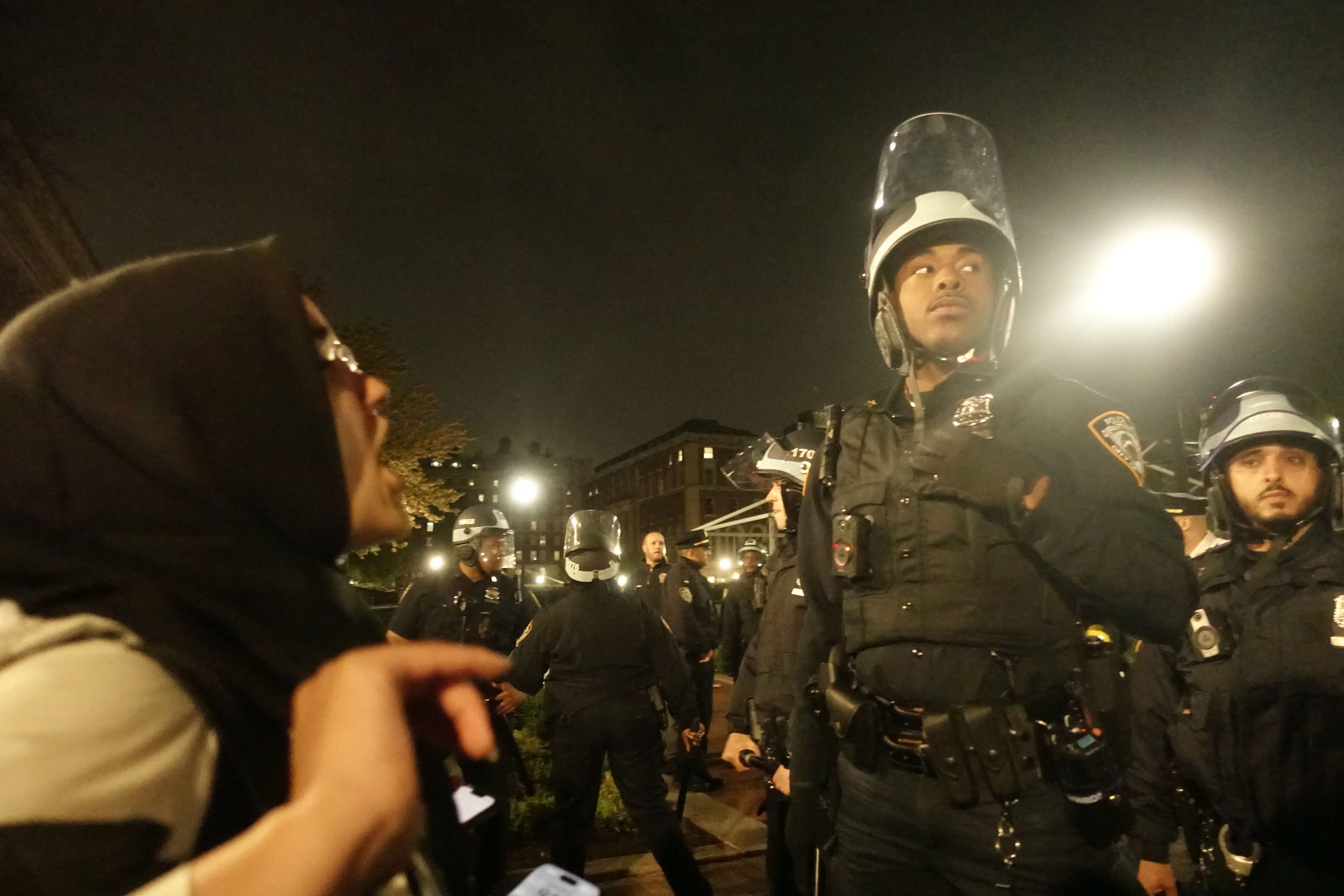
The educational facilities bill has its own backstory. College campuses across the city were roiled by protests against the Gaza war, and in April 2024, the NYPD cleared a pro-Palestinian encampment at City College. That moment accelerated pressure on the Council to act.
For more on the background of the buffer zone dispute, see The CITY’s coverage of the buffer zone fight.
Mamdani told reporters Thursday he hasn’t decided what he’ll do. “I’ve heard from a number of New Yorkers about their concerns about aspects of this legislation,” he said. “And I will be making a decision on that shortly.”
He’s got until April 25. That’s a Friday. The February 25 deadline on the religious sites bill came and went without a veto fight because the math never gave him that option. This time, it does.
The 26 Council members who’d need to override him aren’t all in lockstep. Sponsors believe they can hold 30 votes if it comes to an override. Whether they actually can is a separate question from whether Mamdani wants to find out.
What’s next: Mamdani’s decision is expected before April 25. If he vetoes, the Council will have 30 days to attempt an override.