
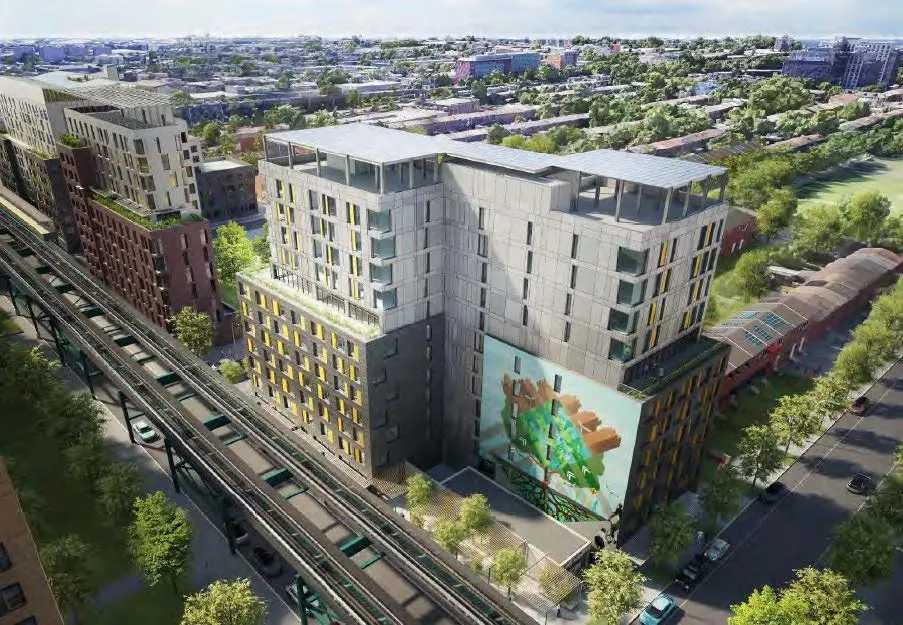
A 13-story affordable senior housing building in Brownsville opened a lottery this week for 47 apartments, with rents calculated as a share of income for residents 62 and older.
The Gail P. Duke Senior Residence at 350 Livonia Avenue sits in the shadow of the elevated train tracks between Mother Gaston Boulevard and Christopher Avenue, a stretch of two-story single-family homes that doesn’t exactly scream high-rise. The 142-unit building serves seniors only. Just 47 of those units carry income restrictions making them available to low-income New Yorkers through the city’s affordable housing lottery system.
Those 47 apartments break down as 24 studios and 23 one-bedrooms. Studios are open to one or two people earning between $0 and $64,800 annually. One-bedrooms go to households of one to three people earning no more than $72,900. Tenants pay a third of their income in rent. An asset limit of $81,000 applies across all lottery units. Rent covers gas for heat and hot water. Tenants pay their own electric bills, including the stove.
That asset cap deserves attention. Seniors who spent decades in Brooklyn, working and saving modestly, can find themselves shut out by an $81,000 ceiling even when their income qualifies. It’s the kind of technical detail that doesn’t show up in a press release but can disqualify someone who’s been waiting years for an apartment like this.
Five percent of units are set aside for households with a mobility disability. Two percent go to households with a visual or hearing disability.
The building was designed by Magnusson Architecture and Planning and developed by Catholic Charities Progress of Peoples Development Corporation. Amenities include a senior center, green space, shared laundry facilities, a computer lab, elevator access, air conditioning, and bike storage. Smoking isn’t permitted. Whether pets are allowed wasn’t specified in the lottery listing.
On-site supportive services will be provided through Catholic Charities Neighborhood Services, including daily hot meals, fitness classes, and senior case management. The development team describes the structure as a “resiliency resource during energy disruptions, flood-related events, or extreme heat,” said the project’s listing materials, a framing that reflects hard lessons from storms and heat emergencies that have repeatedly hammered Brownsville and neighboring low-income communities.
The building earns that framing. It’s all-electric and built to Passive House standards, which means aggressive insulation and minimal energy leakage. The mechanical systems include heat pump water heaters, energy recovery ventilators, a rooftop solar power array, and battery backup storage. Plantings throughout are native species.
None of that is coincidence. Superstorm Sandy hit in 2012, and Brownsville seniors endured some of the city’s longest and most dangerous power outages. A building that can generate its own electricity, store it, and function as a neighborhood refuge when the grid goes down doesn’t just check a green building box. It addresses something real.
Brownsville’s poverty rate has long ranked among the highest in New York City, and the neighborhood’s housing stock reflects decades of disinvestment that even aggressive development can’t quickly reverse. The city launched the Brownsville Planning process in part to address the shortage of affordable housing for seniors, who can’t easily leave the neighborhood when rents climb and options shrink.
The 142 total units in the Gail P. Duke building, 47 of them income-restricted, represent a fraction of what’s needed. But the 350 Livonia project is part of a broader corridor push, with additional affordable development planned nearby. The site’s location near the elevated 2 and 5 lines gives it transit access that seniors relying on the subway will appreciate, even if the trains aren’t exactly quiet neighbors.
Income requirements, household size limits, and full application details are available through The Brooklyn Paper, which first reported the lottery. The deadline hasn’t passed yet. Seniors who think they qualify shouldn’t wait.