
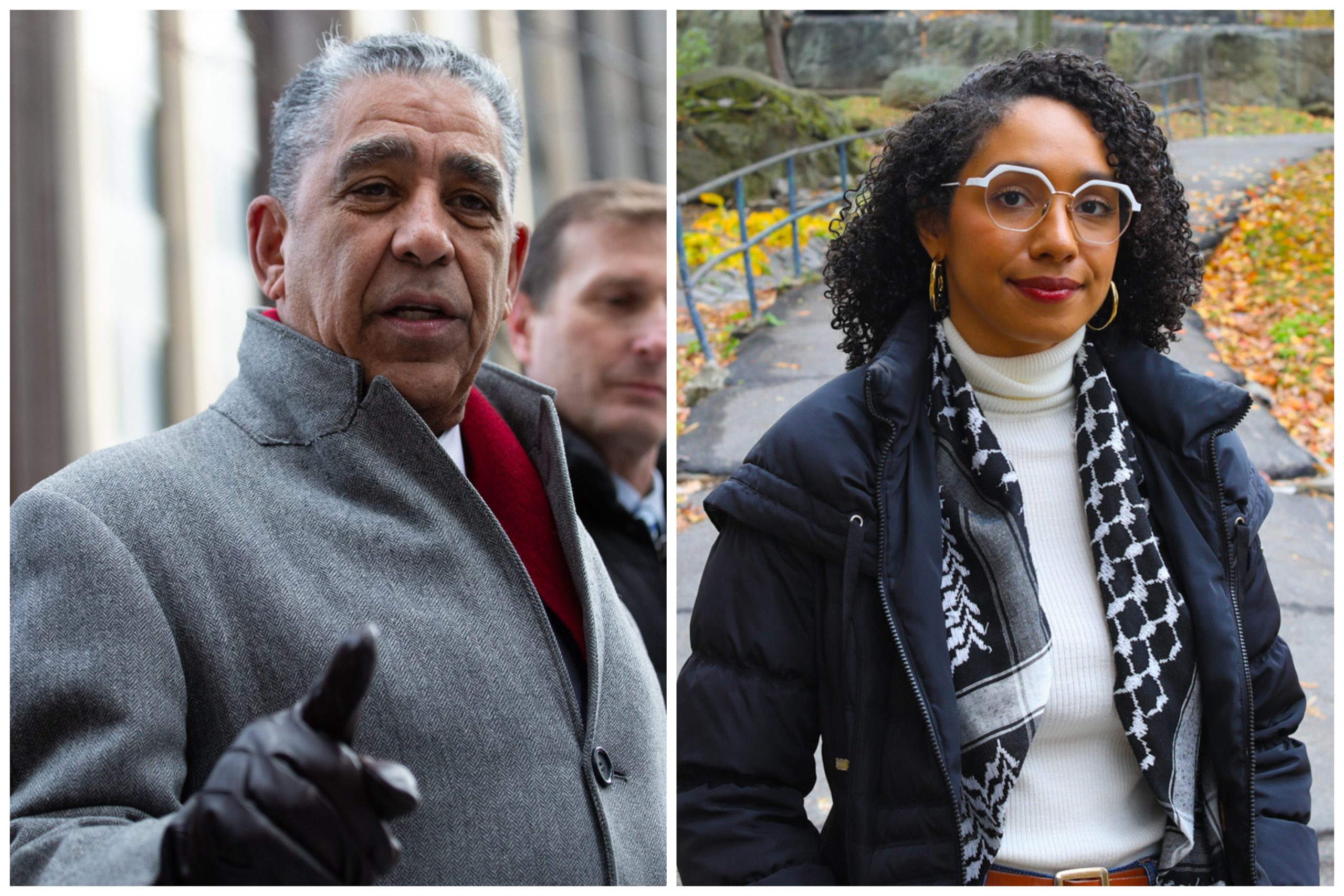
Rep. Adriano Espaillat’s internal poll numbers are underwater, and his challenger’s campaign isn’t being shy about it.
A survey conducted by Upswing Research & Strategy between March 25 and March 30 put Espaillat at just 42% support among likely Democratic primary voters in New York’s 13th Congressional District. The poll covered 598 voters across Upper Manhattan and parts of the Bronx, reached by phone and text, with a 4% margin of error.
On name recognition alone, Espaillat led challenger Darializa Avila Chevalier 42% to 28%. Oscar Romero, a third Democratic candidate, came in at 4%.
Then the pollsters read voters positive messaging about Avila Chevalier. The numbers flipped. She jumped to 46%, Espaillat dropped to 35%, and Romero held at 4%, according to results shared with The City.
That’s the part Espaillat’s team doesn’t want to talk about.
Nobody neutral commissioned this poll. Upswing ran the questions, and the favorable framing for Avila Chevalier was crafted by people who want her to win. Experts don’t treat campaign-backed surveys the same way they’d treat a Siena or Marist number. But with the June 23 primary on the calendar and no independent poll of NY-13 available this cycle, Upswing’s figures are the only public window into where the race stands right now.
Avila Chevalier’s camp didn’t wait long to use the data. “These poll results show what we have long been feeling on the ground uptown and in the Bronx: that New Yorkers are hungry for change, and they know Darializa Avila Chevalier will deliver that change on June 23rd,” campaign manager Ilona Duverge said in a statement.
Espaillat’s camp didn’t budge. “On the ground, Congressman Espaillat has built deep, durable support across Upper Manhattan and the Bronx, backed by a record of delivering and a coalition that turns out,” spokesperson Tyrone Stevens said in a statement.
Stevens didn’t stop there. He argued Avila Chevalier’s operation exists mostly on paper, while Espaillat’s team is working neighborhoods and talking to voters directly. It’s the kind of pushback you’d expect from a five-term incumbent who won the seat in 2016 and hasn’t faced a serious primary threat since. Whether it’s also accurate is what the next two months will determine.
The money race complicates Espaillat’s position more than the poll does. Federal Election Commission filings submitted April 15 show Avila Chevalier raised $270,000 in the first quarter of 2026, compared to Espaillat’s $230,000. That gap made him the only sitting House member from New York City to be out-raised by a challenger this cycle, according to Politico’s read of the FEC data.
He’s got cash, though. A lot of it. Espaillat holds roughly $1 million in reserves against Avila Chevalier’s $220,000. In a primary that’ll be decided by who turns out Washington Heights, Inwood, and the South Bronx on June 23, that kind of war chest funds field staff, mailers, and get-out-the-vote operations that smaller campaigns can’t match dollar for dollar.
Still, the first-quarter fundraising loss stings for an incumbent who should be discouraging challengers, not playing catch-up on the donor circuit.
Incumbents running below 50% in their own party’s primary polling, even in surveys built to flatter their opponent, are showing signs of vulnerability that challengers live for. Avila Chevalier’s campaign now has two data points: a fundraising quarter she won, and a poll she can circulate to donors and endorsers as evidence that Espaillat can be beaten.
Espaillat won NY-13 back in 2016 and has held it since, building a base that extends across Dominican and Latino communities from the northern tip of Manhattan down into the Bronx. That infrastructure doesn’t evaporate because one internal poll went sideways. But he’s running in a district that’s changed, with a challenger who’s found donors and, according to at least one set of numbers, persuadable voters.
The primary is June 23. Qualifying petitions were due by April 15, so the field is set. Both campaigns now have roughly 50 days to make their case.