
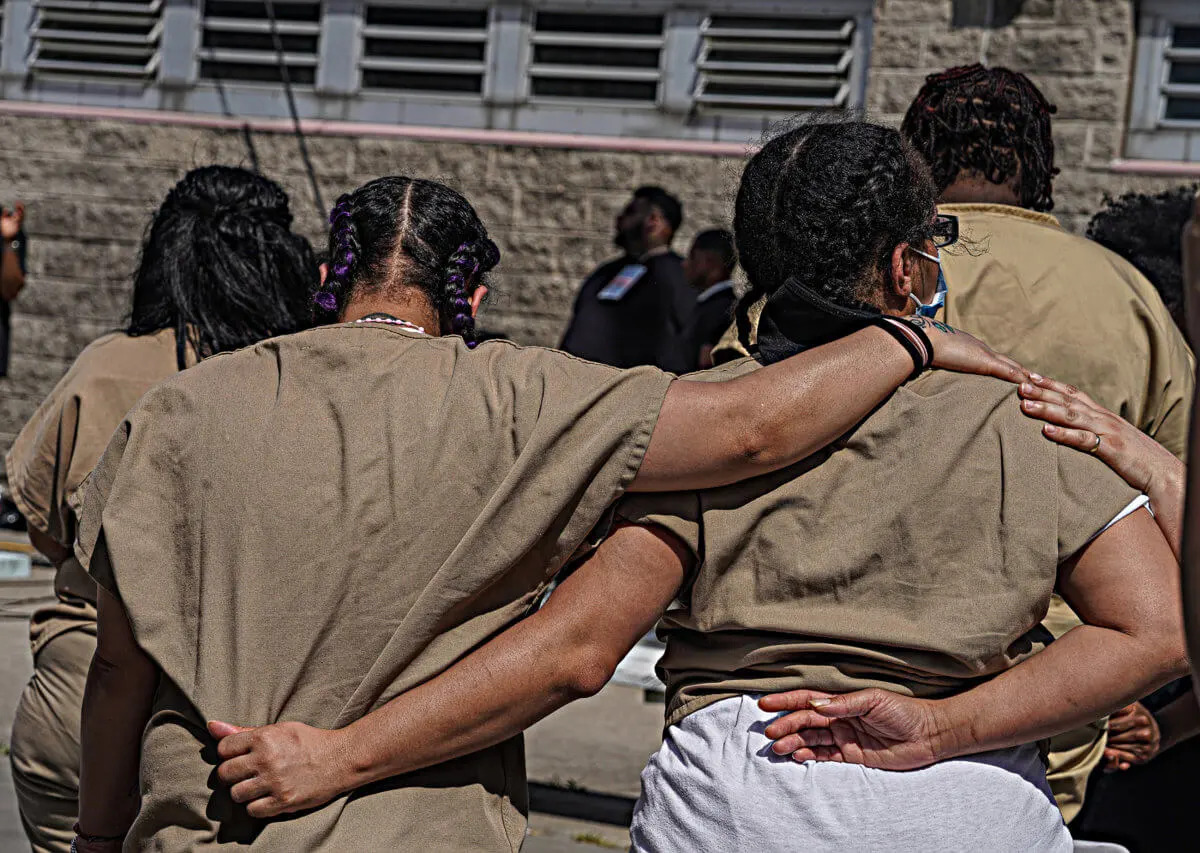
Members of the New York City Council’s Committee on Criminal Justice walked through Rikers Island Monday, confronting corrections officials over how pregnant women are being treated inside the facility.
Committee chair Council Member Selvena Brooks-Powers led the delegation, joined by Council Members Gale Brewer and Yusef Salaam, both from Manhattan. It was Brooks-Powers’ first visit to Rikers since she took over the committee. The three spent the morning at the Rose M. Singer Center, the jail’s women’s facility, meeting with people in custody and taking stock of conditions there.
What they found wasn’t reassuring.
Brooks-Powers told reporters that pregnant women are scattered throughout the jail rather than housed together near the nursery unit. She called that arrangement dangerous, and she pushed the Department of Correction to consolidate pregnant detainees into the nursery. The logic isn’t complicated. Pregnant women should be close to medical support. Right now, they’re not.
“The baby that they’re carrying is not an extension of the sentencing,” Brooks-Powers said. “The baby should be properly cared for. They should get the proper care that they would get anywhere else.”
One pregnant woman Brooks-Powers spoke with said staff were providing her with regular prenatal care. That’s a data point. But the chair’s broader assessment was that pregnant incarcerated women don’t reliably get the proximity to care that their condition demands, and that this population has gone chronically under-scrutinized.
Brewer was direct about the scope of what the delegation saw inside the Singer Center, a facility that incarcerated New Yorkers have long called “Rosies.”
“We spoke directly with the women at the Rose M. Singer Center, young men, and detainees with severe mental illness,” Brewer said. “It is clear that decisions affecting pregnant people in custody require close attention and follow-through. Oversight means showing up, asking questions, and making sure conditions improve now.”
Brewer didn’t sugarcoat the complexity either. Criminal justice oversight doesn’t come with clean answers, she acknowledged. “It’s not a clear path with any of these aspects when we talk about criminal justice,” she said.
Rikers has spent years under a federal monitor appointed to oversee court-ordered reforms following sustained failures on staffing, safety, and in-custody deaths. Progress at the Department of Correction has been slow enough that the monitoring process has prompted repeated clashes between city officials, the court, and advocates including the Correctional Association of New York, which has documented conditions at state and city facilities for decades.
Brooks-Powers didn’t dodge the weight of what her committee is responsible for. The job involves overseeing a jail complex that’s been the subject of consent decrees, federal intervention, and years of political promises that haven’t fully materialized. She described the dual obligation: protecting people in custody while also looking out for the staff working inside and the neighbors those people will return to.
It’s a lot. She said so plainly to amNewYork.
Monday’s tour wasn’t just a walk-through. It’s the kind of direct oversight that the committee can use to build a record, push for specific changes, and force the Department of Correction to respond publicly to what members observed. Whether that translates to action on consolidating pregnant women near the nursery unit is the question that’ll follow Brooks-Powers back to City Hall.
The Singer Center visit is part of a broader conversation the council’s still having about Rikers’ future. The city’s plan to close the island and move to borough-based jails has dragged well past earlier timelines, and conditions at the existing facility haven’t waited for that transition to resolve themselves. Pregnant women held at Rikers are living in those conditions now.
“The baby that they’re carrying is not an extension of the sentencing,” Brooks-Powers said. That line wasn’t rhetorical. It was a demand.