
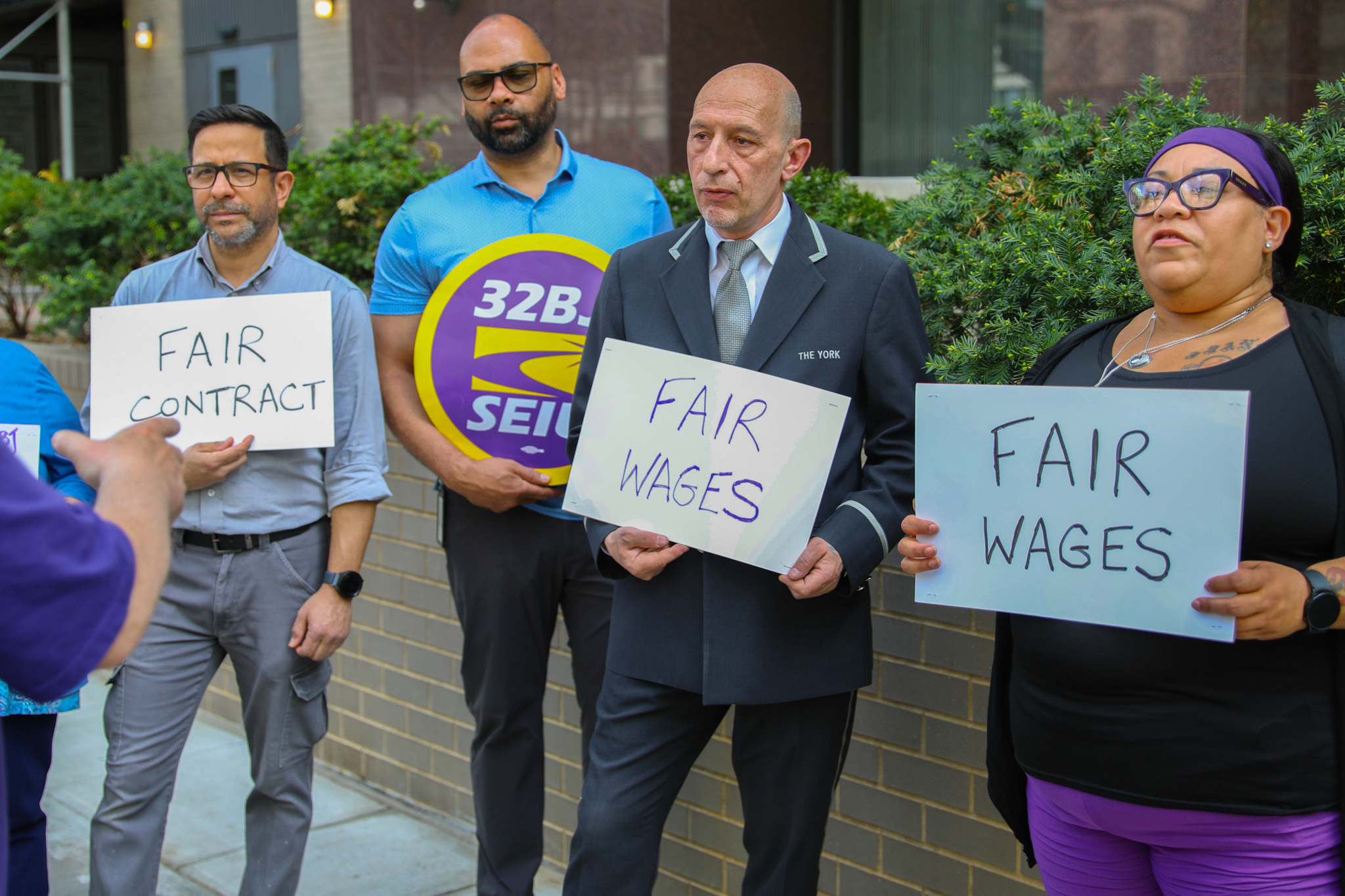
A strike involving more than 34,000 New York City doormen and porters was averted Friday after 32BJ SEIU and the Realty Advisory Board reached a tentative agreement, sparing hundreds of thousands of residents from what could’ve been the borough’s most disruptive labor stoppage in decades.
Negotiators hammered out the deal following an all-week stretch of marathon talks held inside a ballroom at the Midtown Hilton Hotel. Neither side disclosed terms Friday morning. Representatives from both the union and The Realty Advisory Board were set to brief reporters later that afternoon.
The numbers tell you why it mattered. More than 550,000 New Yorkers live in buildings staffed by unionized doormen and porters. That’s everything from rent-stabilized walk-ups in the Bronx to luxury skyscrapers along Billionaire’s Row and storied co-ops like The Dakota on the Upper West Side.
Workers had dug in hard against the central management demand: that building employees begin paying a share of their own healthcare costs for the first time. Employer-paid coverage has been the floor of every contract cycle for years. The Realty Advisory Board argued that rising operating costs, compounded by Mayor Zohran Mamdani’s pledge to freeze rent increases on stabilized apartments, left landlords with little room to absorb labor expenses without some give on benefits. The union said healthcare was a line it couldn’t cross. Period.
“We weren’t going to let 34,000 working families lose what they’ve built over decades of bargaining,” a union spokesperson said.
That standoff is what pushed this week’s talks to the wire. The last time these workers actually struck was 1991. That stoppage ran 12 days. They got to within 24 hours of a walkout in 2022 before a deal landed. This time, the window felt tighter and the political stakes higher.
On Wednesday, more than 10,000 workers flooded Park Avenue for a rally ahead of the strike authorization vote. Mayor Mamdani was there. The crowd stretched for blocks. Building managers across the city had already started prepping residents for the possibility of a full work stoppage, asking volunteers to haul trash and warning that package deliveries could pile up in lobbies. At the San Remo, the landmarked Upper West Side co-op on Central Park West, management had begun putting together contingency plans with the building’s board.
It’s worth being clear about what the healthcare fight actually represents. New York’s luxury residential market sells on service and exclusivity. Six-figure and seven-figure apartments in buildings staffed by doormen don’t come with the expectation that those doormen will eventually be nickel-and-dimed on their medical coverage. High-profile tenants at places like The Dakota have historically pushed back against management moves that create labor friction, and building companies know it. That dynamic doesn’t eliminate the pressure on management, but it does complicate the math compared to, say, a warehouse negotiation in New Jersey.
The Realty Advisory Board’s argument that Mayor Mamdani’s rent freeze constrained revenue was real, if contested. Landlords representing stabilized buildings have said repeatedly since 2026 budget talks began that a freeze would force them to find savings elsewhere. The union countered that cost-cutting on healthcare was a false economy that would destabilize a workforce that keeps some of the city’s most valuable real estate running.
32BJ SEIU represents doormen, porters, and other residential building workers citywide. It’s one of the larger property services unions in the country. The membership heading into Friday’s deadline wasn’t bluffing. Authorization votes don’t fail when workers are told healthcare is on the table.
Check the full details reported by THE CITY for the contract specifics once both sides brief reporters Friday afternoon. The tentative agreement still requires a ratification vote by the membership before it’s final.