
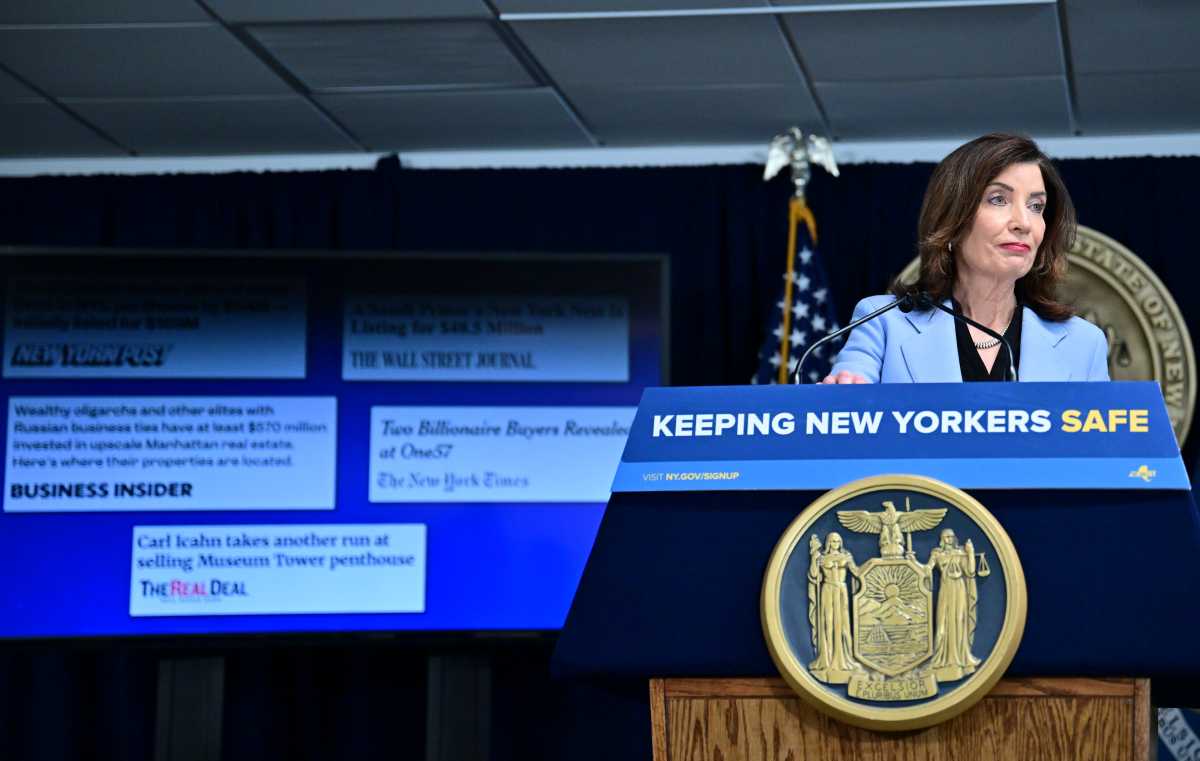
Gov. Kathy Hochul wants Albany to let New York City tax luxury second homes, a move her administration says could pull in at least $500 million a year and give Mayor Zohran Mamdani a real shot at closing a $5.7 billion budget gap that’s been strangling city services since he took office.
The proposal is straightforward: a property tax surcharge on non-primary residences valued at $5 million or more. Hochul plans to include enabling legislation in the state budget. If the Legislature approves it, the city would get authority to impose the surcharge using multiple tax brackets. A source familiar with the plan told amNewYork that some details still need to be worked out with lawmakers and city officials, but the $500 million annual floor isn’t in dispute. That’s not a one-time patch. It’s recurring revenue.
City Council Speaker Julie Menin called it “a smart, sensible proposal.” Mamdani, who’d spent weeks pushing Hochul to go after the city’s highest earners and largest corporations, didn’t hide his enthusiasm either.
Hochul didn’t mince words in her statement. “New York City is the greatest city in the world, and the people who call it home should not be left carrying the burden alone,” she said. “If you can afford a $5 million second home that sits empty most of the year, you can afford to contribute like every other New Yorker.”
The political backdrop matters. From Brighton Beach to the Upper East Side, residents who can’t find a reasonably priced apartment have watched Midtown towers go dark at night for years, entire floors bought by investors and foreign nationals who spend maybe a few weeks in New York annually. The 2023 Housing and Vacancy Survey, conducted by the city’s Department of Housing Preservation and Development and released in 2024, counted roughly 58,800 units citywide that are held for seasonal, recreational, or occasional use. Those numbers cover all five boroughs. The survey doesn’t separate out which of those units crack the $5 million threshold, so the actual taxable pool is still fuzzy.
What isn’t fuzzy: Hochul’s direction. She’s positioning the surcharge as a structural fix, not a stunt.
Mamdani framed it in class terms. He said the plan moves toward closing the city’s fiscal deficit by taxing “the ultra-wealthy and global elites with a pied-à-terre tax.” He’s been in office less than a year and he’s already dealing with a hole in the budget that would give any mayor heartburn. The $5.7 billion gap has forced painful choices on services that millions of New Yorkers rely on daily. A $500 million annual revenue stream won’t solve everything, but it’s not nothing.
Housing advocates have pushed versions of a pied-à-terre tax for years in New York. Albany’s killed it before. The question now is whether Hochul’s direct involvement changes the math in the Legislature. She controls the budget process in ways that individual members don’t, and she’s attaching this to the budget rather than running it as standalone legislation. That’s a harder thing to quietly shelve.
There’s also the question of who actually pays. The $5 million floor is deliberately high. It’s not targeting the schoolteacher who inherited a studio on the Lower East Side or the Bronx family that bought a place in Florida. It’s aimed at the owner of a pied-a-terre in a Midtown supertall who treats New York like an asset class rather than a city. Whether the courts or the Legislature see it the same way will determine how this plays out.
The surcharge would need legislative sign-off before the city could collect a dollar. Hochul’s budget proposal is the opening move. Negotiations with lawmakers come next.
Mamdani’s office didn’t announce a timeline for when the city would actually implement the surcharge if the Legislature acts. The governor’s office said additional design details are still being worked out. But the political signal is clear enough. Albany is being asked to make wealthy second-home owners in New York City pay up.