
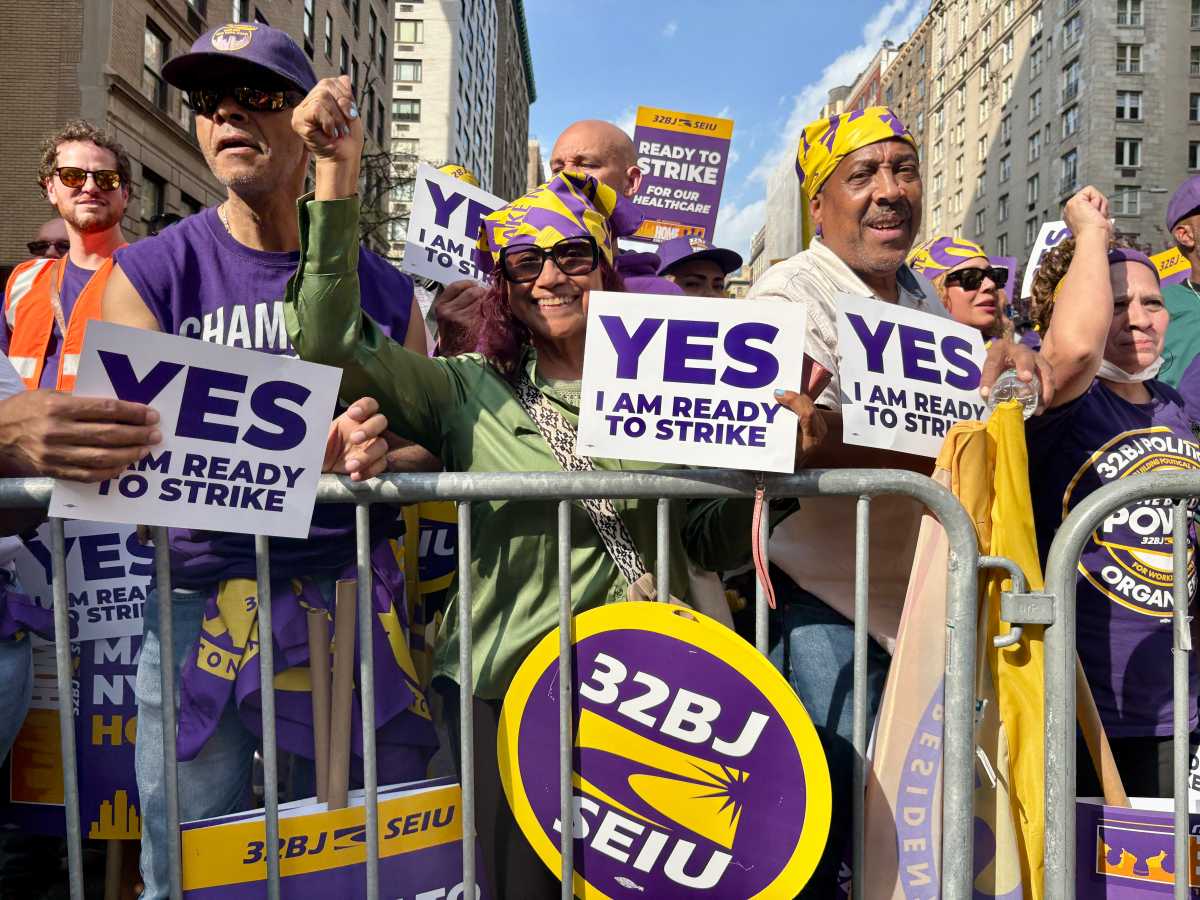
Thousands of building workers voted Wednesday to authorize a strike, with their contract against the Realty Advisory Board set to expire April 20.
The vote puts 32BJ SEIU on a direct collision course with the RAB, the organization that represents residential building owners in contract negotiations. Without a deal, doormen, porters, superintendents and handypersons who keep New York’s apartment buildings running could walk. Think packages piling up in lobbies. Trash sitting uncollected. Boilers going cold.
The core fight is wages, healthcare and pensions. Union members want a real wage increase, no cost-sharing on healthcare, and higher pension contributions. Here’s the number that stops you cold: a full pension currently pays out roughly $15,000 a year. That’s what workers get after careers hauling trash, fixing heating systems and signing for Amazon deliveries in 2026 New York City.
Fifteen thousand dollars. A year.
32BJ has called the RAB’s offer “insulting,” and on Wednesday, SEIU president April Verrett took that message directly to Park Avenue in Manhattan. She didn’t mince words. “It’s not just a contract expiring,” Verrett said. “It’s respect expiring, it’s fairness expiring.”
Union members in purple and gold packed Park Avenue from 79th Street to 82nd Street for roughly three hours, cheering and chanting under warm spring sun while Cherry blossoms lined the avenue. Over a dozen elected officials showed up, including City Council Speaker Julie Menin and Council Majority Leader Sean Abreu, both of whom addressed the crowd. City Comptroller Mark Levine was there. So were Borough Presidents Brad Hoylman-Sigal and Antonio Reynoso. Council Member Farah Louis attended, as did Council Member Shirley Aldebol, who also leads 32BJ’s public school service workers. Harvey Epstein, chair of the Committee on Consumer and Worker Protection, came out too. Brad Lander, who’s running for New York’s 10th congressional district, was in the crowd.
And then there was Mayor Zohran Mamdani.
Mamdani didn’t show up to wave and leave. He told workers plainly that he understands the distance between their daily lives and the lives of the people they serve every single day. “I know that I’m speaking to those who handle DoorDash deliveries for so many, and yet when it comes time for them to go to the grocery store are straining to afford what they need,” Mamdani said. He went further, describing workers who manage luxury cars but can’t get home without sitting on what he called the slowest buses in the country, and workers who maintain multimillion-dollar apartments they’ll never live in.
It’s a sharp contrast. The buildings these workers maintain sit among the most valuable real estate on earth. The men and women who keep those buildings running can’t afford to retire on $15,000. That’s not a rounding error. That’s a structural failure.
The RAB hasn’t publicly responded to the strike authorization. Negotiators have roughly five days to close the gap before workers can legally walk. Whether the two sides are anywhere near a deal isn’t clear, and 32BJ’s tone this week doesn’t suggest they’re feeling generous.
Members who spoke to amNewYork were direct about what they need: wages that keep pace with what it actually costs to live here, healthcare that doesn’t eat into already tight paychecks, and a pension that doesn’t require a second job after thirty years of service.
What happens next depends on whether the RAB moves. If it doesn’t, the workers who run the elevators and manage the heat and drag the recycling to the curb in 11 Manhattan zip codes could be off the job before the week is out. Residents of the city’s biggest residential buildings would feel it immediately.
Verrett made clear this isn’t about one contract cycle. “It’s not just a contract expiring,” she said. “It’s respect expiring, it’s fairness expiring.” That’s the frame 32BJ is taking into what could be the most significant building workers’ labor action New York has seen in years.
Talks continue.