
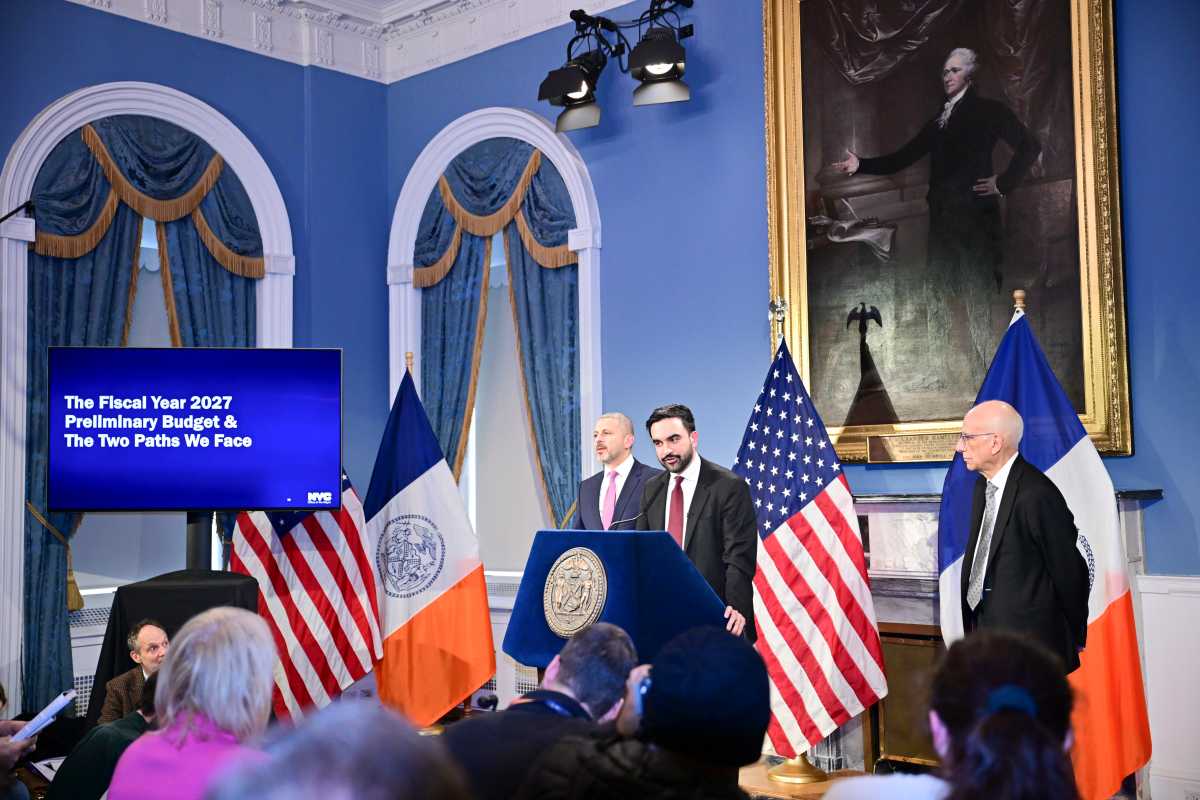
New York City has nearly 14,000 unfilled government jobs, and the City Council’s budget plan counts more than $800 million in savings from those empty desks while promising, in the same breath, to fill them all.
That’s the contradiction sitting at the center of the council’s response to a $5.4 billion budget shortfall that has City Hall searching for any credible number to put on paper.
Mayor Zohran Mamdani’s preliminary budget already took heat for a property tax hike that most city officials treat as a last resort. The council’s counter-proposal didn’t fare much better among fiscal analysts. Budget experts say the vacancy savings calculation looks tidy from a distance and falls apart up close.
“It’s one of those things in which there’s a kernel of truth, but the truth is actually much more complicated,” said Thad Calabrese, a professor of public and nonprofit financial management at NYU Wagner, where he also directs the finance specialization, in an interview with amNewYork.
Here are the numbers. As of January 31, the city carried 13,294 vacancies across 307,777 authorized positions. That’s a 4.3 percent vacancy rate for the municipal workforce as a whole. Drill into the agencies and it gets uglier fast.
The city’s current homeless services budget reflects an agency running at 26.36 percent vacant. The Department of Correction sits at 18.43 percent. The Department of Citywide Administrative Services comes in at 17.46 percent. The Department of Finance carries a 14.64 percent vacancy rate. The Department of Housing Preservation and Development is at 14.06 percent.
That last number, 26 percent at Homeless Services, isn’t an abstraction. It’s roughly one in four positions sitting empty in an agency that places people in shelter, connects them to services, and tries to move cases toward stable housing.
Calabrese walked through why the vacancy math has political appeal even when it doesn’t hold together economically.
“The math is quite simple, right?” he said. “Fewer employees means your personnel expenses will be lower and for New York City, like a lot of cities, a huge chunk of their annual spending are on these personnel costs. So, to the extent that you can keep them vacant, you will reduce your spending in the current year.”
That’s true, as far as it goes.
It doesn’t go very far. Some of the positions the city’s leaving open don’t just cost money when filled. They generate it. A revenue agent at the Department of Finance can bring in more than her salary costs the city. A caseworker at Homeless Services who isn’t there can push downstream costs into shelter systems, overtime, or contracted services that show up elsewhere in the budget. The $800 million in anticipated savings doesn’t account for any of that.
“The actual savings from vacancies oftentimes do not translate into the full amount that its advocates say it will, and part of it is because you have second-order effects or unintended consequences,” Calabrese said.
The Independent Budget Office has documented these dynamics before. Agency vacancies don’t freeze spending at a lower level so much as displace it, often into less efficient corners of the budget.
For the council, the argument is at least partially defensible on one narrow ground: if those 13,294 jobs can’t realistically be filled fast enough to affect this fiscal year’s bottom line, acknowledging the savings isn’t entirely dishonest. City hiring doesn’t happen overnight. Civil service exams, background checks, and onboarding cycles can stretch for months.
But the council’s own position undercuts that defense. It isn’t framing this as a short-term delay. It’s claiming the savings while also claiming it will staff the positions. You can’t have both sides of that ledger.
The $5 million here or there at smaller agencies is noise. The 31 agencies carrying meaningful vacancy rates represent something the city can’t simply bank and move on from. At the Department of Homeless Services, a 26 percent vacancy rate in January means a substantial portion of the workforce managing New York City’s shelter population simply doesn’t exist.
Budget season ends. The jobs stay empty. The costs move somewhere else.