
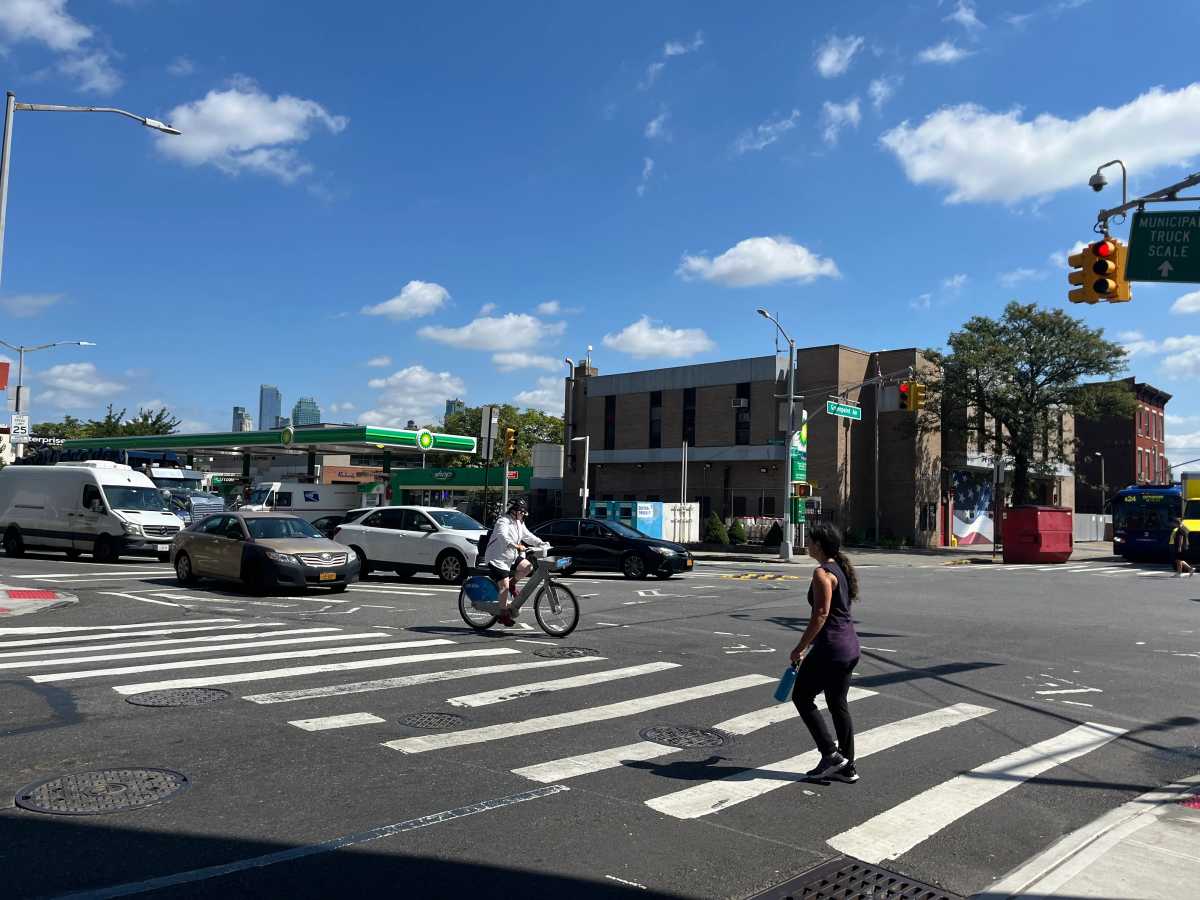
Cyclist counts on McGuinness Boulevard have more than doubled since 2021, and the NYC DOT says the numbers justify pushing the corridor’s redesign all the way north to Freeman Street.
The Department of Transportation brought its findings to Community Board 1 on April 14, laying out what the partial lane reduction on the boulevard’s southern stretch has actually done: peak-hour car volumes down, a broader mix of people cycling, and traffic delays so modest they barely register.
DOT engineer Zach Wyche walked the board through the data. South of Greenpoint Avenue, between 100 and 400 fewer vehicles move through during peak hours compared to pre-redesign counts. Driving north on the boulevard, the weekday trip from Meeker Avenue to Calyer Street adds roughly one minute. Driving south, delays run between five and 60 seconds. That’s the gridlock critics warned about. One traffic light cycle, sometimes less.
The city converted one vehicle lane in each direction into a parking-protected bike lane between Calyer Street and Meeker Avenue in 2024. Fears that overflow would flood nearby residential blocks have only partially materialized. Volume north of Greenpoint Avenue has gone up, and more cars are cutting through Leonard and Humboldt streets, which run parallel to the boulevard. The DOT isn’t disputing that. It’s weighing it against everything else in the dataset.
Still, the agency considers the southern results solid enough to extend the full redesign up to Freeman Street. Mayor Zohran Mamdani made that commitment on his third day in office, and Wyche told CB1 the city would proceed “as soon as the weather warms.” The April 14 presentation was the department’s effort to show Greenpoint residents the evidence before work begins.
None of this came out of nowhere. The full McGuinness Boulevard redesign was approved in 2023, then gutted after one of then-mayor Eric Adams’s top aides was allegedly bribed by local business owners opposed to the plan. The city settled on a compromise: full treatment for the southern half, minor adjustments to the northern half. That backstory doesn’t leave the room when the DOT talks to anyone in Greenpoint about what happens next.
Wyche told the board the sidewalk-riding numbers alone make the case. In 2021, roughly half of cyclists on McGuinness Boulevard rode on the sidewalk. Now almost all of them ride in the street. It’s not complicated. That shift tracks with what protected bike lane research has shown repeatedly: people don’t choose protected lanes because they’re convenient. They choose them because they don’t feel like they’ll get killed.
The lanes are also drawing a different kind of cyclist entirely.
Before the 2024 redesign, McGuinness was mostly the domain of experienced riders who’d already made peace with the chaos of the boulevard. Now Wyche said the DOT is seeing Citi Bike riders, slower cyclists, and families. He attributed the change to physical separation. A painted line doesn’t move parked cars between you and traffic. A parking buffer does.
The Brooklyn Paper coverage of the CB1 presentation documented the board’s reception of the data, which wasn’t uniformly enthusiastic. Concerns about the parallel street impacts, particularly on Leonard and Humboldt, haven’t gone away.
The 18 months of data from the southern stretch represent the city’s strongest evidence yet that the full redesign can work without breaking the surrounding street grid. The question now isn’t whether the numbers support it. The DOT says they do. The question is whether the political will that was killed once, in 2023, holds long enough for Mamdani’s administration to finish what the city started.
Wyche didn’t offer a specific construction start date at the April 14 meeting beyond the mayor’s “as soon as the weather warms” commitment. The 11 blocks between the current northern terminus and Freeman Street represent the corridor’s most contested ground.