
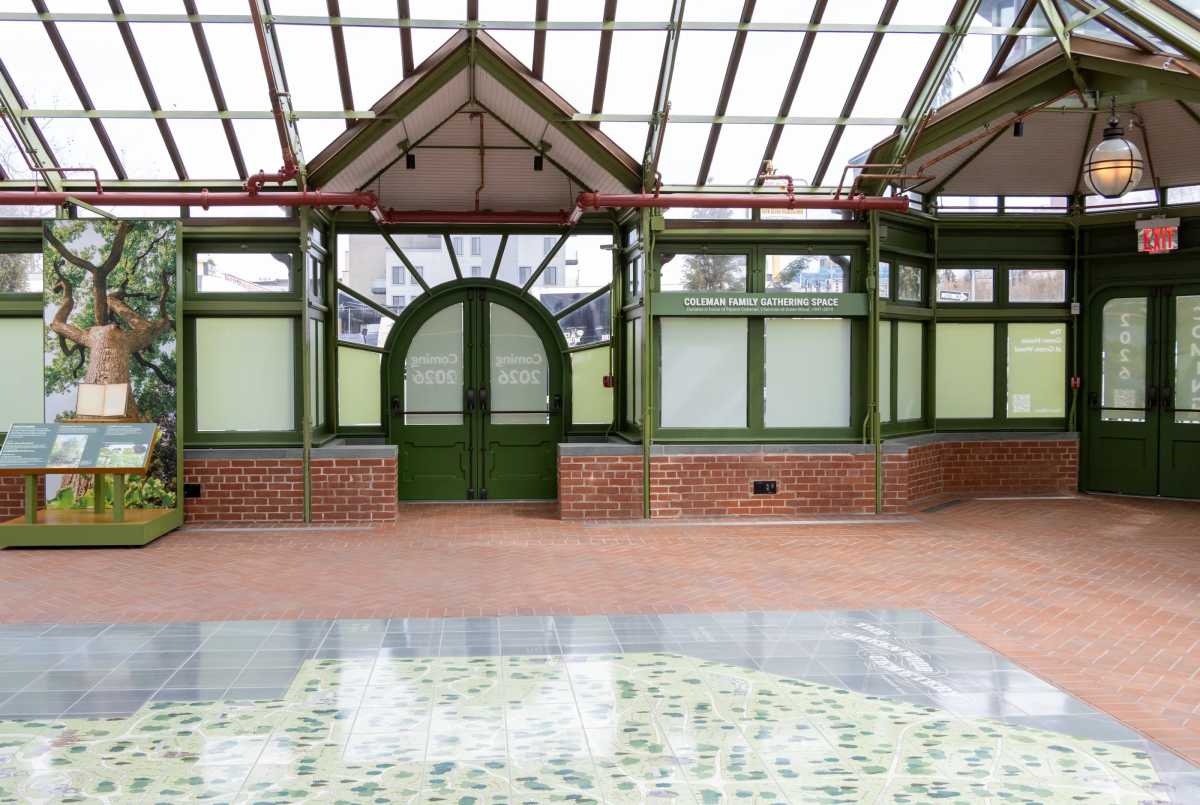
Green-Wood Cemetery has opened a $43 million visitor center inside a restored Victorian greenhouse at Fifth Avenue and 25th Street in Sunset Park, Brooklyn, capping a project more than a decade in the making.
The facility runs 19,200 square feet and pairs a new L-shaped, terra-cotta-clad structure designed by Architecture Research Office with the rehabilitated Weir Greenhouse, a glass-and-copper building with an onion dome that’s anchored that corner since the late 19th century. Green-Wood purchased the greenhouse from McGovern Florists in 2012 for $1.625 million. By then the structure had spent years deteriorating, its frame buckling, window panes gone, the plants long since cleared out.
The cemetery sits directly across Fifth Avenue from 750 Fifth Ave. That proximity made Green-Wood the natural buyer. The restoration took longer than anyone expected, but the result is hard to argue with.
Inside, the center includes exhibition galleries, classroom space, climate-controlled archival storage, staff offices, and restrooms. Weekends bring flowers for sale. A food vendor hasn’t been pinned down yet, though Baked in Brooklyn is right next door.
Lisa Alpert, Green-Wood’s senior vice president of development and external relations, said the project addressed three problems the cemetery couldn’t fix without a building like this. First, visitors needed an entry point that existed outside the gates. Second, the more than 500,000 people who come through each year had no real place to learn about the grounds or the roughly 10,000 schoolchildren who use Green-Wood’s educational programming annually. Third, that programming was running into a seasonal wall every fall. “To a screeching halt around November 1,” Alpert said.
That problem’s solved.
Alpert didn’t soft-pedal what makes the project unusual. “It’s not like we’re a museum opening another wing,” she told the Brooklyn Paper. “We are a cemetery opening a visitor center, which is sort of unheard of.”
She’s not wrong. Cemeteries don’t typically build visitor infrastructure on the assumption that people might want context for what they’re looking at. Green-Wood is betting they do. The cemetery spans 478 acres and holds hundreds of thousands of burials, including figures whose names show up in history textbooks. It’s also a National Historic Landmark. But for most visitors, the institutional knowledge behind all of that has been essentially inaccessible.
“As an institution, we know so much about this place and so much about the people who are buried here, and we’re not sharing,” Alpert said. “We just didn’t have a place for us to impart those stories and share them.”
That’s what the visitor center is meant to fix. Classrooms mean school groups can come in November instead of stopping cold. Exhibition space means the cemetery’s archival holdings, historically locked away, can be put in front of the public. The building isn’t a trophy. It’s operational.
The Weir Greenhouse carries most of the visual weight here. It’s the piece of the project that people who’ve walked past that corner for years will recognize. Green-Wood’s decision to wrap the new Architecture Research Office construction around it rather than replace it was deliberate. The dome and the signage stayed. The copper weathered in place. What changed is everything inside.
The greenhouse’s previous identity as a florist shop wasn’t accidental either. McGovern Florists operated there for years because the location, directly across from a major cemetery entrance, made obvious commercial sense. Green-Wood’s 2012 purchase closed that loop, bringing the building back under cemetery control for the first time in its modern history.
The $43 million price tag makes this one of the more significant capital investments a New York City cemetery has undertaken. Green-Wood isn’t a city agency. It’s a private nonprofit, and it raised that money without municipal backing. Whether the visitor center changes how people think about what a cemetery can be is a longer question. What’s certain is that 500,000 visitors a year now have somewhere to go before they walk through the gates.